 ManaPal
How much is my MTG collection worth?
Short answer: in most collections the value sits in a small number of cards, while the rest is bulk worth a few cents each. To get a real number you need three things for every card that matters: the exact printing, its condition and its current market price. Scanning the cards into a collection app does all three at once and keeps a running total.
What makes a Magic card valuable
| Factor | Why it matters |
|---|---|
| Demand | Cards played in many decks, especially Commander staples and powerful lands, hold their price. A rare nobody plays is still bulk. |
| Printing | The same card can be worth very different amounts depending on the set, the frame (borderless, showcase, extended art) and whether it was reprinted. |
| Foil | Foils usually cost more than the regular version, but not always: check each one. |
| Condition | Near Mint gets the full price; Lightly, Moderately and Heavily Played sell for progressively less. |
| Language | Some languages are more sought after than others for specific cards; most of the time English and the local language of the market sell best. |
| Reprint risk | Cards on Wizards' Reserved List are never reprinted, which is why many old cards are so expensive. |
Step by step: valuing a box of cards
- Pull out the rares and mythics. Look at the expansion symbol: gold means rare, orange-red means mythic rare. These are where most of the value is.
- Check every land that isn't basic. Dual lands, fetch lands and utility lands are often worth more than the spells next to them.
- Separate foils and special frames. They need their own lookup.
- Scan or log those cards first. Get the exact printing right: set code and collector number are in the bottom-left corner on modern cards.
- Grade the expensive ones honestly. Look at edges, corners, surface scratches and whitening on the back.
- Treat the rest as bulk. Commons and uncommons rarely change the total, with a few exceptions you'll spot while scanning.
- Read the total the right way. Market value is what players pay each other. A store's buylist will offer less; selling yourself takes time and fees.
Keep the number up to date
Prices move with new sets, bans and reprints. Rather than valuing your collection once, keep it in an app that refreshes prices and shows the value over time: you'll see which cards are rising and when it's a good time to trade.
How to do it with ManaPal
- Scan your cards with the camera, or import a CSV from ManaBox, Moxfield, Archidekt, Delver Lens, Dragon Shield, Deckbox, TCGplayer or Cardmarket.
- Open the Collection tab: the total value and the number of cards are at the top.
- Open the value card to see how your collection's value has changed over time.
- Use Binders to keep trade cards apart, Sets to track completion and Wishlist for the cards you're after.
- Unsure about condition? Ask Mote to estimate a card's condition from your photos (an AI action that uses Mana).
Prices are based on Cardmarket market data and converted to your currency with ECB exchange rates.
Coming soon on theApp Store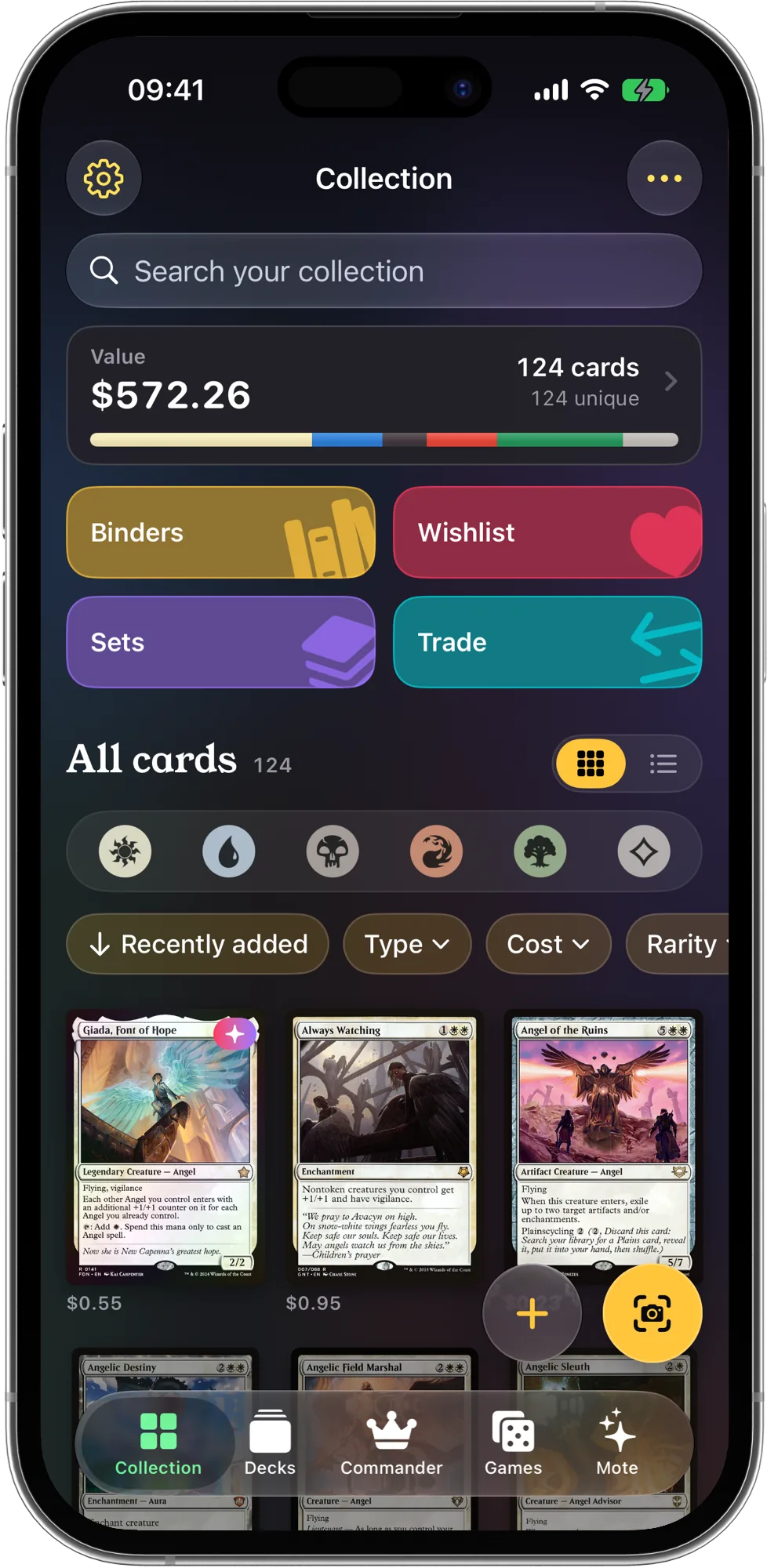
FAQ
Will a store pay me the value I see in the app?
Usually not. Apps show market prices, what cards sell for between players. A store buys at a lower buylist price because it has to resell the card at a profit.
Does condition really change the value?
Yes. Near Mint cards sell for the full price, while Lightly Played, Moderately Played and Heavily Played cards sell for progressively less, especially on expensive cards.
What counts as bulk?
Bulk is the mass of commons, uncommons and low-demand rares worth a few cents each. It is usually sold by the thousand rather than card by card.